The California Freedom of Information Act is more commonly known as the California Public Records Act (CPRA). It was enacted in 1968 to ensure transparency in state and local government operations. The law gives every person the right to inspect, copy, or receive copies of public records held by California government agencies. This includes documents, emails, databases, audio recordings, photographs, and any other recorded information, regardless of format. The goal is to promote accountability and allow residents to monitor how public officials conduct government business. The CPRA applies broadly to all state agencies, county governments, city departments, school districts, special districts, and any entity created or controlled by these bodies. Private organizations and federal agencies are not covered under this law.
Under the CPRA, agencies must respond promptly to public records requests. They cannot charge fees for reviewing or inspecting records. However, they may charge actual costs for producing copies, such as paper, ink, or digital storage media. Agencies have 10 calendar days to respond to a request. If they deny access, they must provide a written explanation citing a specific exemption under the law. Common exemptions include ongoing investigations, personal privacy concerns, and preliminary drafts that are not final. If a record contains both public and private information, the agency must redact the private portions and release the rest. Citizens can appeal denials or file a lawsuit in the superior court to compel disclosure.
What Is Covered Under the California Public Records Act
The California Public Records Act applies to a wide range of materials created, received, or maintained by government agencies in the course of their duties. These records exist in many forms and are not limited to traditional paper documents. The law ensures that transparency extends to digital communications, multimedia files, and archival data. Agencies must preserve and provide access to records regardless of their age or storage method, as long as they remain in the agency’s possession.
Types of Records Included
The CPRA covers all recorded information produced or acquired by a public agency in connection with its official functions. This includes:
- Emails sent or received by government employees using official accounts
- Meeting minutes from city councils, school boards, and planning commissions
- Budget reports, financial statements, and expenditure records
- Police incident reports, arrest logs, and 911 call transcripts (with redactions if needed)
- Building permits, zoning maps, and land use documents
- Contracts, bid proposals, and vendor agreements
- Audio and video recordings of public meetings or law enforcement activity
- Databases containing non-confidential administrative data
Formats and Storage Methods
Records are not limited to physical paper. The law explicitly includes electronic formats such as PDFs, spreadsheets, text messages, voicemails, and cloud-stored files. Agencies must provide records in the format they are kept unless the requester specifies a different format. If a record exists only electronically, the agency must still produce it in a readable form, such as a printed copy or downloadable file. Agencies cannot refuse a request simply because the record is stored on a server or in a legacy system. They are required to make reasonable efforts to retrieve the information using standard search tools.
Agencies Subject to the Law
The CPRA applies to all branches and levels of California government. This includes:
- State departments like the Department of Motor Vehicles, Caltrans, and the Franchise Tax Board
- County agencies such as sheriff’s offices, health departments, and assessor-recorders
- Municipal governments, including city clerks, police departments, and public works departments
- Special districts like water authorities, fire protection districts, and transit agencies
- Public school districts and community college offices
Courts, the California State Legislature, private nonprofits, and federal agencies are exempt from the CPRA. However, courts follow their own rules for public access to case files, and the legislature has separate transparency policies.
How to Request Public Records in California
Submitting a public records request in California requires identifying the correct agency and providing a clear description of the records being requested. Although verbal requests are allowed under the California Public Records Act (CPRA), written requests are recommended because they create a documented record of communication.
Requests may generally be submitted by:
- Online request portals
- In-person delivery
Government agencies are also required to assist requesters in identifying the correct department or records custodian when possible.
Steps for Submitting a Public Records Request
To request records in California:
- Identify the agency that maintains the records.
Criminal justice records, court documents, jail records, property information, and administrative files are usually handled by different agencies. - Describe the records clearly and specifically.
Include names, dates, case numbers, addresses, or subjects whenever possible. - Submit the request through the agency’s official records portal, email address, or records department.
- Include contact information and preferred delivery format (digital copy, printed records, etc.).
- Indicate whether you are willing to pay duplication or processing fees if applicable.
Information Commonly Included in a Request
A complete request typically contains:
- Full name and contact details
- Name of the agency receiving the request
- Detailed description of requested records
- Relevant dates or case references
- Preferred record format
- Statement referencing the California Public Records Act (CPRA)
Providing detailed information helps agencies locate records more efficiently and reduces processing delays.
California Department of Justice Records Requests
The California Department of Justice (DOJ) manages certain statewide criminal justice and background record systems.
- Use the official DOJ website:
- https://oag.ca.gov/
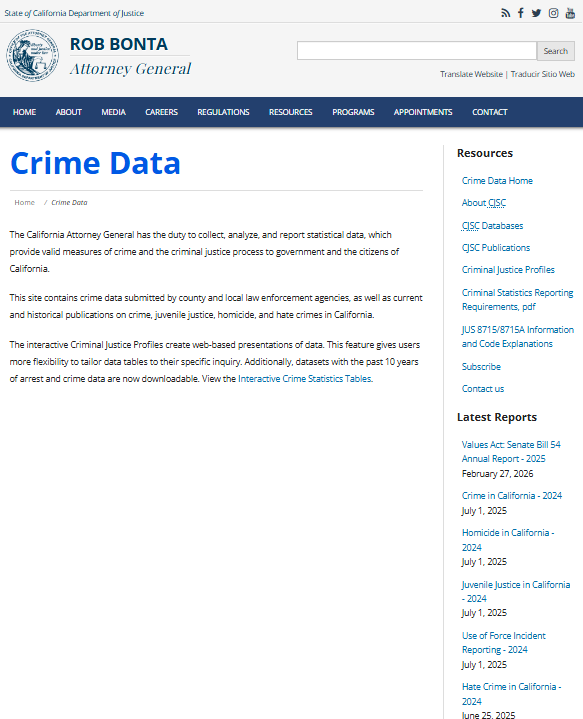
- From the homepage, navigate to:
Public Services → Criminal History Records / Record Review
The DOJ may require:
- Identity verification
- Fingerprinting
- Date of birth and legal name
- Official application forms
Access to criminal history information is restricted under California law and is generally limited to:
- The individual named in the record
- Authorized agencies
- Parties permitted by statute
California Public Records Act Exemptions
While the CPRA promotes openness, it recognizes that some information must remain confidential to protect privacy, security, or effective government operations. These exceptions are narrowly defined and must be justified in writing if a request is denied. Agencies cannot withhold entire records simply because a small portion is exempt. They are required to redact only the protected information and release the remainder.
Privacy-Based Exemptions
Personal privacy is a major reason for withholding information. The CPRA protects the private lives of individuals, especially public employees, from unnecessary exposure. Exempt information includes:
- Social Security numbers, driver’s license numbers, and bank account details
- Home addresses and personal phone numbers of government employees
- Medical records and mental health evaluations
- Birth dates, marital status, and family information of public workers
- Personnel files containing performance reviews, disciplinary actions, or salary history (unless required by law)
These protections prevent identity theft, harassment, and unwarranted intrusion into private lives. For example, a police officer’s home address cannot be disclosed even if it appears in an official report.
Law Enforcement and Security Exemptions
Agencies may withhold records that could interfere with active investigations or endanger public safety. This includes:
- Ongoing criminal investigations where disclosure could tip off suspects
- Unexecuted search warrants or arrest warrants
- Surveillance techniques, informant identities, or undercover operations
- Emergency response plans and infrastructure vulnerability assessments
- Preliminary notes or internal memos not yet finalized
For instance, a sheriff’s department may delay releasing details about an active manhunt to avoid compromising the operation. Once the case is closed, most records become accessible.
Deliberative Process and Draft Exemptions
The CPRA allows agencies to withhold preliminary drafts, notes, and internal communications that reflect the decision-making process. These are protected to encourage candid discussions among officials. Examples include:
- Draft legislation or policy proposals not yet adopted
- Internal emails debating budget cuts or staffing changes
- Staff recommendations that were ultimately rejected
- Unpublished reports are still under review
Once a decision is final and implemented, related records generally become public. The exemption is not meant to hide corruption but to preserve the integrity of internal deliberations.
Response Time and Agency Obligations
California law sets strict deadlines for how quickly agencies must respond to public records requests. These timelines ensure that transparency is not delayed by bureaucratic inertia. The 10-day rule is central to the CPRA and applies to all state and local agencies. Failure to meet this deadline can result in legal consequences.
10-Day Response Rule
Agencies have 10 calendar days from the date they receive a request to provide one of the following responses:
- Grant the request and provide the records
- Deny the request with a written explanation citing a specific exemption
- Notify the requester that more time is needed and provide an estimated completion date
If the agency needs more than 10 days, it must justify the delay. Common reasons include the need to search large volumes of records, consult with legal counsel, or redact sensitive information. The agency must still act in good faith and complete the request as soon as possible.
Providing Records in Accessible Formats
Agencies must provide records in the format they are kept unless the requester asks for a different format. For example, if emails are stored in a database, the agency can provide them as a CSV file or printed copies. They cannot force requesters to use electronic formats if they prefer paper. Additionally, agencies must assist individuals in locating records, especially if the request is broad or unclear. This includes helping to identify the correct department or file name.
Fees and Cost Recovery
Inspecting records is free. Agencies cannot charge for the time spent locating or reviewing documents. However, they may charge for the actual cost of duplication, such as:
- Paper and ink for printed copies (typically $0.10 to $0.25 per page)
- USB drives or CDs for digital files
- Postage if mailing is required
Fees must be reasonable and based on actual expenses. Agencies cannot profit from public records requests. If the cost exceeds $25, the agency must notify the requester in advance and obtain approval before proceeding.
Appealing a Denial or Withholding
If an agency denies a public records request or fails to respond within 10 days, the requester has the right to appeal. The CPRA provides a clear path for challenging denials, including administrative review and court action. Most disputes are resolved without litigation, but legal recourse is available when necessary.
Administrative Appeal Process
The first step is to file a written appeal with the agency’s head or designated records officer. The appeal should include:
- A copy of the original request
- The agency’s denial letter or proof of non-response
- A statement explaining why the denial is incorrect
- Any supporting evidence or legal arguments
The agency has 10 additional days to respond to the appeal. If the appeal is denied, the requester can escalate the matter to the California Attorney General’s Public Records Portal or file a lawsuit in the superior court.
Filing a Lawsuit in Superior Court
If administrative appeals fail, the requester may sue the agency in the county where the records are located. The court can order the release of records, award attorney’s fees to the requester if they win, and impose penalties on the agency for unreasonable delays. Lawsuits must be filed within one year of the denial. Courts apply a “public interest” test, weighing the need for transparency against any claimed exemptions.
Role of the California Attorney General
The Attorney General’s office provides guidance and mediation for public records disputes. While it does not directly handle individual requests, it publishes official opinions on CPRA interpretation and maintains a public records request portal for state-level agencies. Citizens can report non-compliance or seek clarification on legal standards.
California Public Records for Journalists, Researchers, and Citizens
The CPRA serves a wide range of users, from investigative journalists to academic researchers and everyday citizens. Each group uses public records for different purposes, but all benefit from the same legal framework. The law is designed to be accessible to everyone, regardless of technical expertise or legal background.
Journalists and Media Organizations
Reporters rely on public records to uncover corruption, track government spending, and report on public safety. Common requests include:
- Police use-of-force reports and misconduct investigations
- Campaign finance disclosures and lobbying records
- Environmental impact reports and regulatory violations
- Public employee salaries and pension data
Many newsrooms have dedicated public records teams and use standardized request templates to improve efficiency. Some collaborate with nonprofit organizations like the First Amendment Coalition for legal support.
Academic and Independent Researchers
Researchers use CPRA requests to gather data for studies on policy, urban planning, education, and social services. They often seek large datasets, such as:
- Crime statistics by neighborhood and year
- School test scores and graduation rates
- Public health records on disease outbreaks
- Transportation usage and infrastructure projects
Agencies may require researchers to sign data use agreements if the information contains sensitive details. Researchers should specify the purpose of their request to help agencies prioritize and process it faster.
Citizens and Community Advocates
Ordinary residents use public records to stay informed about local issues, such as:
- Zoning changes affecting their neighborhood
- Water quality reports and utility billing practices
- Code enforcement actions and building violations
- Public meeting agendas and voting records
Community groups often file joint requests to monitor government actions and advocate for transparency. Many cities now publish records online to reduce the need for formal requests.
| Agency | Address | Phone | Hours |
| California Department of Justice | Public Records Unit, P.O. Box 944255, Sacramento, CA 94244-2550 | (916) 210-6600 | Monday–Friday, 8:00 AM – 5:00 PM |
(FAQs) About the California Freedom of Information Act
California public records laws give individuals the right to inspect and obtain government documents from state and local agencies. These requests often involve response deadlines, agency obligations, fees, email disclosure rules, and legal remedies when records are denied. The following FAQs explain how the California Public Records Act works in practical situations and what requesters should expect during the process.
What happens if a California agency refuses to release records without a valid reason?
Under the California Public Records Act, agencies must provide a written explanation when denying a request, citing a specific exemption in Government Code Section 6254. If the denial lacks legal justification, the requester can file an administrative appeal with the agency head. If that fails, they may sue in superior court. The court can order the release of records and award attorney’s fees to the prevailing party. Agencies found to have acted in bad faith may face additional penalties. It is illegal for an agency to ignore a request or delay response beyond 10 calendar days without justification. The law favors disclosure, and exemptions are interpreted narrowly. Requesters should keep copies of all correspondence and note the dates of submission and response.
Can I request public records anonymously in California?
Yes, the California Public Records Act does not require requesters to provide their name or personal information. However, agencies may ask for contact details to communicate about the request, such as delivery method or fee payment. Some online portals, like the Department of Justice’s criminal history portal, require identity verification for privacy reasons, but general records requests do not. Anonymous requests are processed the same as named ones, but requesters may miss updates if they do not provide a valid email or phone number. It is advisable to use a pseudonym or organizational email if privacy is a concern, but avoid false information that could delay processing.
Are emails between California government employees considered public records?
Yes, emails sent or received by government employees in their official capacity are public records under the CPRA, regardless of whether they are sent from a government or personal account. This includes messages about policy decisions, budget discussions, or public events. However, personal emails unrelated to government business are not subject to disclosure. Agencies must preserve work-related emails and produce them upon request. If an email contains both public and private content, the private portions must be redacted. Employees should be aware that their communications may be subject to public review and should avoid using personal accounts for official business to prevent confusion.
How long does it take to receive public records after a request is approved?
Once an agency approves a request, it must provide the records “promptly.” The CPRA does not specify an exact timeline beyond the initial 10-day response window, but agencies are expected to act without unnecessary delay. Simple requests, such as a single document, may be fulfilled within days. Complex requests involving large datasets or redactions may take weeks or months. If the agency estimates a delay, it must notify the requester and provide a completion date. Requesters can follow up if no response is received. In urgent cases, such as ongoing public safety issues, courts may order expedited processing.
Can I be charged for searching or reviewing public records in California?
No, agencies cannot charge fees for the time spent searching for, reviewing, or redacting public records. The CPRA only allows charges for the actual cost of duplication, such as paper, ink, or digital media. This ensures that cost is not a barrier to access. If an agency quotes a fee that includes staff time, it is violating the law. Requesters should ask for a breakdown of costs and challenge excessive charges. Some agencies offer fee waivers for requests that serve the public interest, such as those made by journalists or nonprofits. Low-income individuals may also request reduced fees based on financial hardship.